

The beauty industry is undergoing a rapid transformation that goes far beyond the boom of Instagram and other social media platforms. Driven by technological advancements, evolving consumer preferences, and a growing emphasis on sustainability, the beauty industry is becoming a dog eat dog world like never before. This includes but is not limited to the salon founder, beauty entrepreneur, operator and staff, the booth renter, and also for the consumer. While these changes present exciting opportunities, they also contribute to a significant economic divide that affects both emerging and established professionals and the consumer. High costs associated with professional, personal and technical development, business operations, and marketing create formidable barriers for those striving to establish themselves in the professional business industry.
Long seen as a pathway to creative freedom, financial independence, and career growth, the beauty industry paved a pathway that provided avenues with unlimited potential compared to your typical “9-5.” However, the economic realities facing business owners, stylists, and consumers today paint a much different picture. An increasing divide is forming, driven by a broken cosmetology education system (Read Part 1 of this Blog Series Here), the rising cost of living, and a dwindling number of profitable salons. With only 8.2% of salons being profitable, salon owners, stylists, and consumers alike are feeling the effects of an industry struggling to sustain itself.
In part 2 of this series, we’re diving deeper into how these changes have had a ripple effect on the beauty industry pertaining to salon owners and business operations.
The Burden on Salon Owners and Beauty Entrepreneurs: A Cycle That Seems to Never Ends
Is the Salon Owner or Novice Beauty Pro Earning the ROI They Deserve?
Said beauty professional has now made their way out of school, and found a salon home. However, due to this lack of preparation, many new stylists spend their first year apprenticing or interning under experienced stylists or salon owners, often making minimal income while still needing to invest in tools, education, and marketing just to get started. The financial burden of building a career—buying shears, color kits, styling tools, and taking advanced courses—can cost thousands of dollars. Without proper mentorship, many new beauty professionals struggle to become fully independent, and those who do often take years to reach financial stability.
If you’re a salon owner reading this, you’re probably thinking, what about me and my profit drain while having associates on pay roll? You’re right – the only one taking the financial hit isn’t just the stylist, it’s also the salon owner. The decline in cosmetology education quality isn’t just affecting students—it’s also forcing salon owners to bear the cost of training underprepared stylists. They must hire apprentices and invest time and money into their development, hoping they will eventually grow into full-time, revenue-generating stylists.
Unfortunately, once these apprentices gain experience, they leave for booth rental opportunities or independent careers, leaving the salon owner and mentors back at square one i.e. hiring slow, mentor stylists unable to double book to maximize income, and leaving the culture fractured, to name a few.
This cycle is financially draining for salon owners. Are you starting to see the trickle down effect? And we haven’t even begun to broach turnover. Without strong, skilled stylists staying long-term, many salons struggle to retain clients, making it harder to cover overhead costs like rent, product inventory, payroll and guest perks (snacks, drinks, birthday incentives, points programs, etc.).
If this trend continues, the industry will see an increase in underqualified stylists, a further decline in salon profitability, and an even wider economic divide between high-end stylists and struggling entry-level professionals. To reverse this, beauty schools must improve training quality, modernize their marketing strategies, and adapt to industry trends to attract both students and clients alike. And, since beauty consumers are more informed than ever, they understand that certain services require years of expertise, making them hesitant to trust a student or new stylist. Totally understandable. But, how are novice stylists, most likely in debt and trying to make ends meet, able to afford education if their employer does not provide this for them? Couple this with the majority of seasoned stylists in the same boat, statistically speaking?
Check, check this thing on? If this wasn’t clear already… We have a huge problem in our industry and if we don’t do something, getting good hair is going to come at a huge premium. It’s as if we’re going back into time. When only royals had good hair, and everyone else was giving each other haircuts that looked unfit…for a king :-()
And although I am all for getting paid fairly (and handsomely depending on your professional expertise), we also want the stylist that genuinely wants to provide a quality service for those that deserve one. There are beauty professionals and consumers alike that care deeply about this industry and deserve for their talents and passions to be a part of it, at a rate that won’t break the bank but will also provide a living wage.
Speaking of which, what does that look like? Making a “livable wage?”
Average Costs of Living in an Urban City
To dive in here, we’re going to use Austin, Texas as our home base. To live comfortably in Austin, this requires an annual income that aligns with the city’s cost of living, which has been on the rise in recent years (from 2015 to present). Here’s a breakdown of the necessary income levels: For a more comfortable lifestyle that includes savings and discretionary spending, higher income levels are suggested:
- Single Adult: A recent analysis indicates that to live comfortably in Austin, a single adult would need to earn about $99,757 annually, or $44.12 per hour. This estimate follows the 50/30/20 budgeting rule, allocating 50% of income to necessities, 30% to wants, and 20% to savings or debt repayment. The Boss Magazine+1CultureMap Austin+1
- Family of Four: For a family of four (two adults and two children), the combined income needed to maintain a comfortable lifestyle in Austin is approximately $223,891 per year. CultureMap Austin
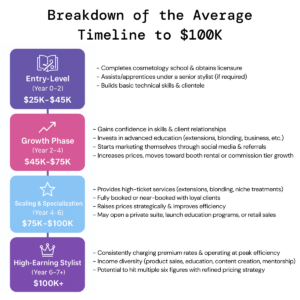
Now, let’s investigate how long it will take said (single) Austinite, who just graduated from school, to make the $99K+ to live in their city. The average timeline for a beauty professional to become a six-figure stylist varies based on several factors, including their business model (commission, booth rental, or independent ownership), education investment, location, and marketing strategies. However, most stylists who reach the $100,000+ take-home income mark follow a trajectory that spans 3 to 7 years, with outliers achieving it faster through aggressive marketing, niche specialization, and premium pricing. Please keep in mind that the below table doesn’t even touch debt. Approximately three out of four American households (around 77.4%) carry some type of debt, with the most common being mortgage, auto, and credit card debt, with student loans coming in as a close 4th. The State of America
For beauty professionals, becoming a six-figure stylist isn’t just about mastering the perfect balayage or executing precision cuts—it’s about continuous reinvestment in your career. The beauty industry evolves rapidly, and those who thrive at the top are the ones who consistently upgrade their skills, business acumen, and marketing strategies. Beyond honing technical expertise, successful stylists understand the importance of education, investing in high-quality tools, and staying ahead of trends through specialized training. Whether it’s enrolling in advanced coloring workshops, attending industry conventions, or purchasing high-end shears, every financial commitment is a stepping stone to a more profitable career.
Education plays a crucial role in scaling your income. Some of these expenses are taken on by the salon owner e.g. hiring educators through distribution companies and/or beauty brands. However, with only 8.25% of salons being profitable in the United States, many Beauty establishment owners are placing these costs back on to the stylists.
Free social media tutorials can provide inspiration, but real transformation happens when stylists invest in structured programs. Hands-on training, online courses, and mentorship opportunities all provide deeper insight into cutting-edge techniques and business strategies. Additionally, learning beyond the chair—such as marketing, financial literacy, and client retention techniques—can make the difference between a stylist who merely survives and one who flourishes. When you treat education as an investment rather than an expense, you open the door to consistent client demand, premium pricing, and long-term success.
The cost of continued education varies widely, depending on the format and depth of training.
Below is a breakdown of different educational opportunities available to stylists, along with their average price ranges:
Types of Stylist Education & Average Costs
| Education Type | Description | Average Cost Range |
| Online Universities | Comprehensive courses on hair science, coloring, business management, and branding | $500 – $5,000 |
| Boot Camps | Intensive multi-day training focusing on specific skills like advanced cutting, blonding, or hair extensions | $1,000 – $3,500 |
| Demo Classes | Watch industry leaders perform techniques, often held at trade shows or online | $50 – $500 |
| Hands-On Workshops | In-person, practice-based education with live models and expert guidance | $500 – $2,500 |
| One-on-One Mentorship | Private coaching on technical skills, branding, and business strategies | $1,500 – $10,000 |
| Industry Conventions & Trade Shows | Large events featuring live demos, product launches, and networking opportunities | $200 – $1,200 (plus travel) |
| Salon Certification Programs | Brand-specific training for color lines, extension methods, or product education | $300 – $2,000 |
| Mastermind Groups & Business Coaching | Focused on marketing, pricing strategies, and scaling a beauty business | $1,000 – $5,000 |
| Apprenticeship Programs | Long-term hands-on learning under a master stylist | Often unpaid or low-cost |
By strategically investing in education and the right tools, stylists can position themselves as industry leaders, increase their service prices, and build a sustainable six-figure income. The key is to view each investment as a means to elevate both skillset and business growth—because in this industry, knowledge truly is profit.
But, BIG BUT, actually ..Have you done the math? Because it ain’t “mathing.” How are beauty professionals going to receive education when they’re so far in debt and have what seems to be no way of getting out of it?
The Challenge of Subscription-Based Learning Platforms
In an effort to acquire necessary skills and certifications, many stylists turn to online learning platforms. However, these platforms often operate on subscription-based models, which may not be financially feasible for individuals at the start of their careers. The cumulative cost over time can add up, especially when combined with other expenses.
Moreover, platforms such as Kajabi, which provide course creation and hosting services, charge fees that can be overwhelming for new stylists lacking a substantial online presence. Without a significant following on social media platforms like Instagram, driving traffic to these courses becomes a daunting task, leading to limited income generation and financial strain. The competition for attention in the digital space is fierce, and standing out requires not only high-quality content but also strategic marketing efforts, which can be costly and time-consuming.
The truth is, these pressures stack: from the debt of a salon owner, to the novice stylists, business start-up costs. From buying the functional tools that we outlined in Part 1 to the financial squeeze explored here—tuition, supplies, rent, (not to mention) marketing, and now the pay-to-play mechanics of course platforms that reward big followings over big hearts. This is exactly where the industry’s scarcity mindset takes root: prized education locked behind high-ticket gates and private audiences, leaving emerging pros—often already in the red—on the outside looking in.
Part 3 of this series highlights licensed and practicing beauty professionals, focusing on how to maximize ROI without overspending—especially if you’re paying off debt or still working to niche and grow in your market. We’ll unpack how that mindset quietly limits impact and income for everyone, and we’ll share a different path forward by introducing the solution that addresses the three biggest challenges facing the beauty industry and everyone connected to it. We’ve got a marketplace, Stylists Pay Stylists, that meets beauty professionals where they are with bite-size, affordable learning, built-in visibility beyond your own following, and fair economics (think: keep more of what you earn) so educators, business owners and learners rise together.